The countdown is on.
Starting January 1st, 2026, Joint Commission will roll out major updates that will impact all healthcare professionals, including healthcare facilities management (HFM) and healthcare technology management (HTM) teams. The new approach, dubbed Accreditation 360, significantly decreases the number of standards reviewed and streamlines patient safety practices – the biggest evolution of the Joint Commission accreditation process since 1965. With the reorganization of compliance standards on the horizon, making adjustments now to align with new expectations is key to maintaining compliance during and after the switch.
Recently, ASHE and FSI teamed up for a webinar on the upcoming changes and how teams can take action to prepare. If you missed it, here’s what FSI’s experts – Mike Zimmer, Director of Customer Solutions, and Chris Lang, SVP, Product & Strategy – covered in the session.
Why This Matters
Compliance isn’t optional – it is a critical operational priority. The Joint Commission updates
won’t change the work you do every day, but they will change how that work is reported and audited. The new approach aims to foster engagement and improvement during the 3-year survey cycle, supporting healthcare systems to make strides in patient care quality and outcomes long-term.
For organizations already stretched thin, failing to adapt effectively could mean costly survey findings and operational headaches.

What's Changing
Joint Commission is consolidating and renaming standards, shifting from Environment of Care (EC) and Life Safety (LS) to Physical Environment (PE) codes and related categories. Here’s what that means:
- New Naming Structure: EC and LS standards will now fall under PE codes, with additional references to emergency management and National Performance Goals.
- Altered Elements of Performance (EPs): Previously, standards were broken into multiple EPs (e.g., EP 1, 2, 3). Accreditation 360 is removing, revising, and consolidating standards into single, homogenized EPs – making reporting more complex.
- Crosswalk Documentation Required: Facilities must map old standards to new ones using Joint Commission's disposition guide and survey process guide.
What This Means for Your Team
The work itself doesn’t change – your ITMs, schedules, and completion rates remain the same. What changes is how you prove compliance. Reporting will require clean, well-classified data and documentation that aligns with the new structure.
What You Can Do to Prepare
There is still time to set your team up for success in the transition to new requirements. Here’s where you can focus efforts to ensure processes, data, and staff are on the same page for 2026:
- Audit Your Current Data: Ensure your asset categories and procedures are correctly mapped to existing EPs.
- Update Code References: Use Joint Commission's crosswalk and disposition guides to align your CMMS with new standards.
- Educate Your Teams: Technicians and managers need to understand how their work impacts compliance reporting.
- Automate Where Possible: A healthcare-specific CMMS can centralize standards, link them to procedures, and generate inspection-ready documentation automatically.
Read our recent article, “Preparing for 2026 Joint Commission Compliance: Key Facility Readiness Steps,” for more guidance on adapting to the upcoming changes.
How Your CMMS Can Help
A robust CMMS should:
- Maintain a centralized standards library with hierarchical structure for easier compliance management and record keeping.
- Link regulatory requirements to asset categories and procedures for clear documentation.
- Automate documentation generation for digital or print submission for stress-free inspections.
- Support continuous readiness for any AHJ – Joint Commission, DNV, or local authorities for consistent alignment with regulatory expectations.
January 1st isn’t far away. Start now by reviewing your compliance strategy, updating your
CMMS configuration, and training your teams. These changes are an opportunity to streamline workflows, digitize reporting, and reduce survey stress.
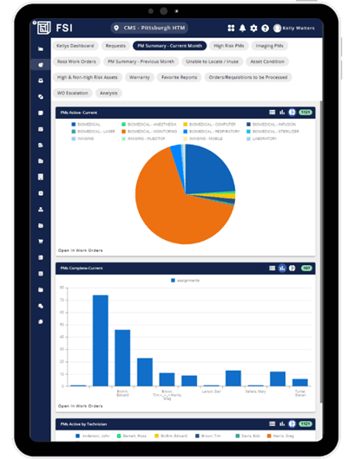
As a healthcare-specific CMMS, FSI has prioritized easing the transition to new compliance standards for our customers. Our Joint Commission Update Solution has done the heavy lifting with updated standards and procedures to align with shifting regulatory expectations. We've also updated our digital compliance management tool, eBinders, to further centralize essential data.
Interested in talking about how a system built for healthcare keeps teams confidently compliant? Let's chat.